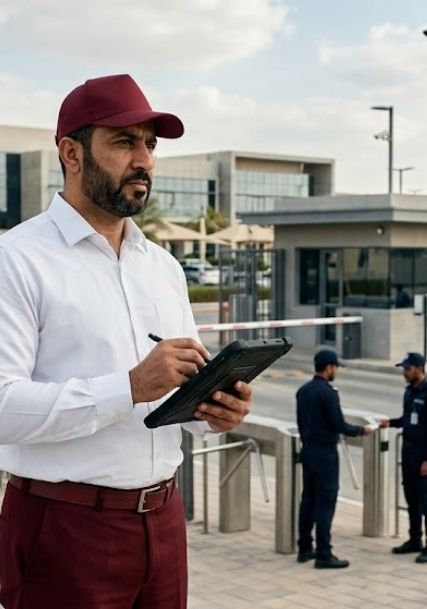
Security Guard Duties and Responsibilities in KSA
What security guards in Saudi Arabia are legally permitted and trained to do on-site.
Published: 2026-03-05 · 8 min read
Understanding what security guards in Saudi Arabia are legally permitted to do — and what they are not — is essential for any business deploying security. Misunderstanding guard authority can create liability exposure, operational confusion, and confrontations that escalate unnecessarily. This guide covers the legal framework, core duties, and the critical limits of guard authority in KSA.
Security guards in Saudi Arabia operate within a legal framework established by the Ministry of Interior (MOI). Guards are private citizens in uniform. They do not have police powers. Their authority is limited to access control, observation and reporting, and reasonable use of force in self-defence or defence of persons in immediate danger. Guards cannot conduct arrests, perform searches without consent, or detain individuals.
The Legal Framework Governing Security Guards in Saudi Arabia
Saudi Arabia's security industry is regulated by the Ministry of Interior through the Private Security Activities Regulations. Key provisions include:
- Security guards must be employed by MOI-licensed security companies
- Guards must hold an individual MOI security personnel certification
- Guard conduct is subject to both the Private Security Regulations and the Saudi Labour Law
- Guards who exceed their legal authority may expose themselves, their employer, and their client to civil and potentially criminal liability
- Use of force is permitted only as a proportionate response to a direct, immediate physical threat
Core Duties of Security Guards in Saudi Arabia
Access Control
Access control is the primary duty of most deployed security guards in Saudi Arabia. This involves verifying visitor and contractor identity against an approved access list, logging all persons entering and exiting a restricted area, operating vehicle access barriers, refusing access to persons who cannot satisfy entry requirements, managing queues and preventing tailgating, and coordinating with reception or facility management for visitor clearance approvals. Access control authority is derived from property law, not from any police-like authority.
Patrol and Observation
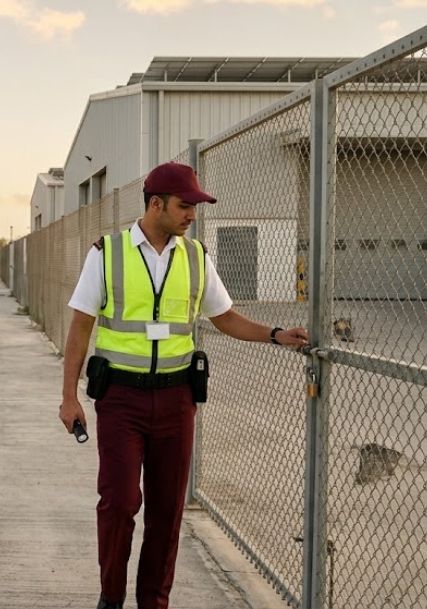
Guards assigned to patrol duties conduct systematic observation of assigned areas, recording their activity through guard tour systems or written patrol reports. Patrol duties include completing assigned patrol routes at specified intervals, checking perimeter fencing and access points for signs of tampering, identifying and reporting maintenance issues and safety hazards, monitoring CCTV feeds where integrated, and identifying suspicious behaviour and reporting to supervisors or police.
Incident Reporting
Documentation is a core professional responsibility for security guards in Saudi Arabia. Every significant event — from a refused-access attempt to a medical incident or theft — must be recorded in an occurrence book or digital incident management system. This creates an audit trail that protects the client in any subsequent legal or insurance proceedings.
Emergency Response
Guards are often the first responder to emergencies on site. Core emergency response duties include calling the appropriate emergency service (Civil Defence 998, Ambulance 911, Police 999), implementing the site emergency evacuation plan, providing basic first aid until emergency services arrive, controlling access to the incident area, and documenting the incident sequence for the formal incident report.
Customer Service and Communication
In many Saudi business contexts — particularly retail, hospitality, and corporate office deployments — security guards serve a dual function as the first point of contact for visitors. Professional guards are expected to deliver information, direct visitors, and manage access queries with the same standard of service as a reception officer.
What Security Guards in Saudi Arabia Cannot Do
- Cannot conduct arrests: Only police officers have the power of arrest in Saudi Arabia. Guards can temporarily prevent someone from leaving if a criminal offence has been committed in their presence, but must immediately contact police (999).
- Cannot perform searches without consent: Guards cannot search individuals without explicit consent. For organisations requiring searches, this must be communicated as a condition of entry.
- Cannot use force as access control enforcement: Force is limited to proportionate self-defence or defence of others in immediate physical danger.
- Cannot access private information systems: Guards monitoring CCTV must work within the scope defined by the facility's privacy policy.
- Cannot make legal accusations or conduct quasi-interrogations: If a guard suspects someone of theft, they can report to management and police, but cannot formally accuse or interrogate.
Sector-Specific Responsibilities in Saudi Arabia
Healthcare: De-escalation of emotionally distressed visitors, clinical zone access management, coordination with hospital security management during emergency codes, infection control awareness.
Construction Sites: Contractor credentialing, Iqama verification for non-Saudi workers, vehicle permit logging, material movement documentation, plant and equipment logging at site exit.
Retail and Mall: Loss prevention observation (not search powers), suspicious behaviour reporting, CCTV monitoring, receipt verification at exit in high-theft environments.
Events: Crowd management at entry, bag screening where agreed as condition of entry, prayer time crowd management, emergency evacuation coordination with Civil Defence, gender-segregated access management.
Residential Compounds: Visitor pre-registration verification, contractor access logging, resident vehicle identification, curfew enforcement, after-hours patrol.
Frequently Asked Questions
Security guards have very limited detention powers. They can temporarily prevent someone from leaving if they have witnessed a criminal offence, but must immediately contact police (999) and hand over to them. Extended detention without police involvement is not legal.
MOI-licensed security guards in Saudi Arabia are generally unarmed. Armed security in the private sector is restricted to specific high-security environments under separate MOI authorisation.
Guards who suspect theft should observe and report. They should not accuse, physically intervene, or conduct a search without consent. The appropriate response is to contact management and police and document the incident accurately.
Guards can request identity documents as a condition of entry to a private property. Individuals can refuse, in which case the guard's only authority is to deny entry, not to detain or search.
All security guards must complete training certified by accredited institutions aligned to Saudi Security Training Academy standards, covering access control, emergency response, incident reporting, Saudi law relevant to guard authority, and first aid.
Report the incident in writing to the security provider immediately. The incident should be formally documented. If the breach involves use of force or detention, notify the police and seek legal advice.
Conclusion
Security guards in Saudi Arabia operate within a clear and professionally defined legal framework that provides significant value when understood and applied correctly, and creates serious liability when misapplied. Ensuring your guards are trained to the right standard and supervised by a quality provider is the foundation of effective deployment. MaySaedu connects businesses with MOI-licensed providers whose guard training programmes embed correct legal authority from day one.
Related Articles
2026-01-15
Security Guard Salary in Saudi Arabia (2026 Guide)
Understand security guard salary ranges, allowances, and what drives pay levels in KSA.
2026-01-28
How Much Does a Security Guard Cost in Saudi Arabia?
A complete breakdown of security guard costs in KSA - daily, monthly, and event rates.
2026-02-10
How to Hire Security Guards in Riyadh
Step-by-step guide to hiring MOI-licensed security guards in Riyadh, Saudi Arabia.